
Harvesting energy from the day-to-day movements of the human body and turning it into useful electrical energy, is the focus of a new piece of research involving a ÀÖ²¥´«Ã½ÊÓƵ Professor.
 Academics from Northwestern
Polytechnical University in China, supported by Professor Richard Fu from Northumbria, have developed a
unique design for sensors capable of using human movements - such as bending,
twisting and stretching - to power wearable technology devices including smart
watches and fitness trackers.
Academics from Northwestern
Polytechnical University in China, supported by Professor Richard Fu from Northumbria, have developed a
unique design for sensors capable of using human movements - such as bending,
twisting and stretching - to power wearable technology devices including smart
watches and fitness trackers.
Self-powered pressure sensors are one of the key components used in these smart electronic devices which are growing in popularity today. The sensors can operate without the need for external power supplies.
Detecting health conditions and measuring performance in sport are among the potential uses for these types of sensors. As a result, they are the focus of extensive research and development, but remain challenging to produce with the performance sensing, flexibility, and sufficient level of power needed for wearable technology.
A new research paper published in the prestigious international scientific journal, , describes how the team led by Professor Weizheng Yuan, Professor Honglong Chang and Associate Professor Kai Tao from Northwestern Polytechnical University (NPU), has worked with Professor Fu to develop a solution.
Their novel method involves using sophisticated materials with pre-patterned pyramid shapes to create friction against the silicone polymer known as polydimethylsiloxane or PDMS. This friction generates a self-powering effect, or triboelectricity, which can significantly enhance the energy available to power a wearable device.
 Professor Tao from NPU explained:
“This results in a self-powered tactile sensor with wide environmental
tolerance and excellent sensing performance, and it can detect subtle pressure
changes by measuring the variations of triboelectric output signal without an
external power supply. The sensor design has been tested and is
capable of controlling electrical appliances and robotic hands by simulating
human finger gestures, confirming its potential for use in wearable technology.”
Professor Tao from NPU explained:
“This results in a self-powered tactile sensor with wide environmental
tolerance and excellent sensing performance, and it can detect subtle pressure
changes by measuring the variations of triboelectric output signal without an
external power supply. The sensor design has been tested and is
capable of controlling electrical appliances and robotic hands by simulating
human finger gestures, confirming its potential for use in wearable technology.”
Professor Fu added: “This self-powered sensor based on hydrogels has a simple fabrication process, but with a superb flexibility, good transparency, fast response and high stability.”
The research is supported by the . NPU is one of ÀÖ²¥´«Ã½ÊÓƵ’s key international strategy partners. Professor Fu, with a key research area in Smart Materials and Microsystems, has been working with collaborators in NPU for a number of years. Their research has also produced papers published in prestigious scientific journals including , , , , , and . Four of their jointly published papers are now listed as ‘highly cited’ or ‘hot papers’ on the website, , which analyses academic citations and research impact.
Professor Honglong Chang, Dean of School of Mechanical Engineering at NPU, said Northumbria University is one of their most important international partners.
“One of our important tasks this year is to further promote the cooperative relationship with ÀÖ²¥´«Ã½ÊÓƵ,” he explained. “We are organising NU-NPU bilateral academic forums this year, and we look forward to establishing strong collaborations in various research areas with ÀÖ²¥´«Ã½ÊÓƵ.”
Professor Jon Reast, Pro Vice-Chancellor (International) at ÀÖ²¥´«Ã½ÊÓƵ, said he was delighted with the success of the partnership with NPU. “It’s fantastic that this research collaboration is proving successful and producing such ground-breaking work.
“We work closely with more than 500 partner universities, colleges and schools across the world. Within these, NPU is one of a set of extremely high-quality research-led university partners. The relationship with NPU includes researchers within smart materials engineering as well as smart design and is producing some truly excellent, impactful, research in both areas.”
Full details can be found in the Advanced Science paper, .
Department of Mathematics, Physics and Electrical Engineering
This department encompasses all of our work in Mathematics, Statistics and Physics including Astrophysics, Electrical and Electronic Engineering, Energy, Smart Materials, Microelectronics and Communications.
This is the place to find all the latest news releases, feature articles, expert comment, and video and audio clips from ÀÖ²¥´«Ã½ÊÓƵ
Latest News and Features

Northumbria named in UK's top 50 employers of veterans
ÀÖ²¥´«Ã½ÊÓƵ has been named one of the 50 GREAT British Employers of Veterans 2026…
AI in policing: safeguards can't keep up, new research warns
Artificial intelligence is being adopted across policing and the wider criminal justice system…
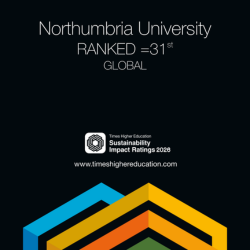
Northumbria in top 35 universities worldwide for sustainability
ÀÖ²¥´«Ã½ÊÓƵ is officially one of the best universities in the world for sustainability,…
.png?modified=20260624091022)
ÀÖ²¥´«Ã½ÊÓƵ launches The North Edit Magazine
ÀÖ²¥´«Ã½ÊÓƵ has published the first edition of The North Edit, a new high-quality…
Northumbria researchers provide economic evidence base for shift away from animal testing
New research commissioned by Lush shows the UK's non-animal methods sector grew to more than…

More power, less noise: what wind energy can learn from wildlife
A ÀÖ²¥´«Ã½ÊÓƵ researcher has secured a prestigious national grant to redesign wind…

OBE for researcher whose work has helped protect firefighters
A ÀÖ²¥´«Ã½ÊÓƵ academic whose work has helped modernise fire service operations and…
More events
Upcoming events

-
REVEAL Architecture
Architecture Studios

-
REVEAL Interior Design
City Campus East 2
-
REVEAL Fashion Exhibition
City Campus East 2

-
REVEAL Graphic Design
Squires Workshops
