
A ÀÖ²¥´«Ã½ÊÓƵ researcher has secured a prestigious national grant to redesign wind turbine blades by borrowing two of nature's most elegant aerodynamic solutions: the humpback whale's ridged flippers and the near-silent feathers of the barn owl.
 Project WHOWL – short for WHale and OWL-inspired
synergistic aerodynamic–aeroacoustic control for wind turbine blades – has a
total value of approximately £500,000. Around £400,000 comes from UK Research
and Innovation () through the Engineering and Physical Sciences Research
Council (), with the remainder contributed by ÀÖ²¥´«Ã½ÊÓƵ and
the University of Leeds
Project WHOWL – short for WHale and OWL-inspired
synergistic aerodynamic–aeroacoustic control for wind turbine blades – has a
total value of approximately £500,000. Around £400,000 comes from UK Research
and Innovation () through the Engineering and Physical Sciences Research
Council (), with the remainder contributed by ÀÖ²¥´«Ã½ÊÓƵ and
the University of Leeds
It is one of only 15 projects selected across the UK under EPSRC's flagship programme – a £6 million initiative to translate biological adaptations into engineering breakthroughs.
WHOWL is the only project in the cohort focused on wind energy, and the only one led from the North East of England.
For years, wind turbine engineers have been caught between two competing demands: the blade designs that generate the most electricity also tend to make it louder, forcing a choice between more power or less noise.
To comply with noise regulations, particularly at night, operators routinely reduce how fast the blades spin and adjust how they are angled into the wind, sacrificing up to 5% of a site’s clean energy potential in the process.
The challenge grows as turbines get larger: longer blades mean higher blade-tip speeds, which push up aerodynamic noise unless carefully controlled.
 WHOWL’s
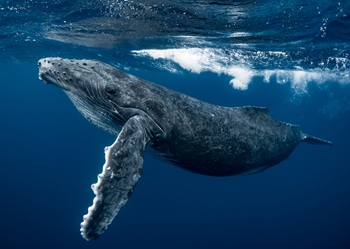
answer is to look to nature for a solution. Humpback whales manoeuvre their
vast bodies with remarkable agility, thanks to distinctive bumps, known as
tubercles, along the leading edge of their flippers.
WHOWL’s
answer is to look to nature for a solution. Humpback whales manoeuvre their
vast bodies with remarkable agility, thanks to distinctive bumps, known as
tubercles, along the leading edge of their flippers.
These bumps generate small, controlled vortices that keep flow attached to the flipper even at steep angles, allowing the whale to keep generating lift where a smooth surface would stall – the same principle WHOWL aims to harness on a turbine blade.
 The
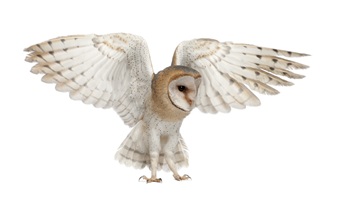
barn owl tackles the same problem differently. A soft fringe along the trailing
edge of its wing feathers breaks up the turbulence that would otherwise turn
into noise, allowing it to fly in near silence.
The
barn owl tackles the same problem differently. A soft fringe along the trailing
edge of its wing feathers breaks up the turbulence that would otherwise turn
into noise, allowing it to fly in near silence.
Both adaptations have been studied individually in engineering contexts, but they have never been combined on a single wind turbine blade as a co-designed system.
WHOWL's central idea is that the two adaptations could work better together than either does alone – with the whale-inspired bumps altering airflow in a way that makes the owl-inspired trailing edge, whether serrated or fringed, more effective at reducing noise.
The 24-month project, starting in October this year, will test and computationally model hybrid blade designs using ÀÖ²¥´«Ã½ÊÓƵ’s wind tunnel facility and Higgs High-Performance Computing (HPC) cluster – a multi-million-pound, university-wide computing facility designed to accelerate advanced scientific research and intensive data modelling.
The team is targeting a 5% improvement in energy output and a reduction in noise of 6-10 decibels – the equivalent of roughly halving the perceived loudness of the turbine.
If achieved at scale, deployment across the UK's fleet of around 10,000 wind turbines could potentially recover around three terawatt-hours of electricity a year – enough to power around a million UK homes, the equivalent of the entire domestic electricity needs of the North East of England. It would also avoid approximately one million tonnes of COâ‚‚ from gas-fired backup generation entering the atmosphere.
 Speaking
about the project, Dr Xiang (Shaun) Shen,
Senior Lecturer in Aerodynamics at ÀÖ²¥´«Ã½ÊÓƵ, said: “I've been fascinated for years by the idea that the
answers to some of our hardest engineering problems are already out there,
shaped by millions of years of evolution.
Speaking
about the project, Dr Xiang (Shaun) Shen,
Senior Lecturer in Aerodynamics at ÀÖ²¥´«Ã½ÊÓƵ, said: “I've been fascinated for years by the idea that the
answers to some of our hardest engineering problems are already out there,
shaped by millions of years of evolution.
“The humpback whale and the owl have each evolved their own way to move efficiently and quietly, and we're bringing both solutions together on a single wind-turbine blade for the first time.
“If we're right, it means wind turbines won't have to choose between generating more power and being quieter, and that could unlock a real amount of clean energy for the UK.
“Being the only wind energy project in this national programme is a real responsibility, and a fantastic opportunity to put the North East at the forefront of this field.”
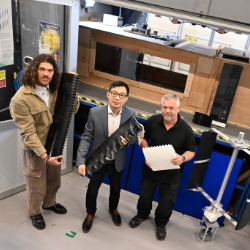
Dr Shen leads the project from Northumbria, with support from senior faculty technician Martin Purvis, and postgraduate research student Vlad Volodkovic.
, project co-lead and an expert in the biomechanics of animal movement at the University of Leeds, said: “As a biologist, I am fascinated by the extraordinary ways in which evolution has shaped animals to meet specific challenges.
“Whales have evolved adaptations to enable efficient movement through water, while owls possess specialised features that allow them to fly with remarkable stealth.
“By understanding the biological principles that underlie these adaptations, we can translate nature’s designs into technologies that address global challenges such as sustainable energy.”
The project is supported by domestic and international organisations: , the UK's leading technology innovation and research centre for offshore renewable energy based in Blyth; , a Canadian company that has commercialised whale-inspired technology; and in the United States, home of , the world’s leading authority on the fluid dynamics of cetacean locomotion and the founder of WhalePower.
The project also includes an unusual feature built into the EPSRC programme: a ring-fenced £75,000 dedicated to developing early-career researchers – . This investment directly addresses the job insecurity that postdoctoral researchers commonly face.
WHOWL’s postdoctoral researcher will receive specialist training in computational fluid dynamics and experimental flow measurement in the UK and at ORE Catapult’s Blyth facility, as well as a research visit to Professor Fish at West Chester University in the United States and international conference opportunities.
WHOWL supports Northumbria’s Energy Futures and Biodesign for the Bioeconomy research themes and aligns with the university’s Strategy 2030 and its commitment to achieving net zero by 2040.
As the only North East-led project in the EPSRC cohort, it also reinforces the region’s growing role in the UK’s offshore wind supply chain.
BioFutures explores and exploits molecular biosystems to develop transformative solutions for a more sustainable and healthy society.
The vision of Energy Futures is to help meet this need by driving forward innovative research-driven approaches to create a cleaner energy future for all.
Our energy materials and systems research uses fundamental physics, chemistry and engineering to develop new ways to generate and store renewable energy - to help deliver a cleaner and greener future.
This is the place to find all the latest news releases, feature articles, expert comment, and video and audio clips from ÀÖ²¥´«Ã½ÊÓƵ
Latest News and Features

Northumbria named in UK's top 50 employers of veterans
ÀÖ²¥´«Ã½ÊÓƵ has been named one of the 50 GREAT British Employers of Veterans 2026…
AI in policing: safeguards can't keep up, new research warns
Artificial intelligence is being adopted across policing and the wider criminal justice system…
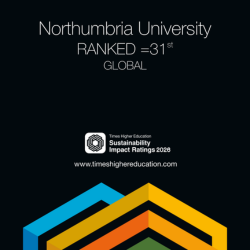
Northumbria in top 35 universities worldwide for sustainability
ÀÖ²¥´«Ã½ÊÓƵ is officially one of the best universities in the world for sustainability,…
.png?modified=20260624091022)
ÀÖ²¥´«Ã½ÊÓƵ launches The North Edit Magazine
ÀÖ²¥´«Ã½ÊÓƵ has published the first edition of The North Edit, a new high-quality…
Northumbria researchers provide economic evidence base for shift away from animal testing
New research commissioned by Lush shows the UK's non-animal methods sector grew to more than…

More power, less noise: what wind energy can learn from wildlife
A ÀÖ²¥´«Ã½ÊÓƵ researcher has secured a prestigious national grant to redesign wind…

OBE for researcher whose work has helped protect firefighters
A ÀÖ²¥´«Ã½ÊÓƵ academic whose work has helped modernise fire service operations and…
More events
Upcoming events

-
REVEAL Architecture
Architecture Studios

-
REVEAL Interior Design
City Campus East 2
-
REVEAL Fashion Exhibition
City Campus East 2

-
REVEAL Graphic Design
Squires Workshops
