ֲýƵ

Skip navigation

2nd April 2015

Crime Story, a collaboration between ֲýƵ and New Writing North, is a series of seminars that aim to debunk the myths for crime writers. Madalyn Rokisky-Ring, a student of Northumbria’s MA Conservation of Fine Art, shares her thoughts on Crime Story’s recent forensics session and the links between conservation and forensic science.

I am a crime TV show fanatic. I can, maybe not so proudly say, that I have seen every episode of Bones and Law and Order: SVU to name just two shows I enjoy. Crime based narratives are intriguing to television viewers and even more fascinating to the audience is feeling like there is an understanding of how these narratives link their ‘perp’ to the crime. What I can also say is that I am currently studying to become a paper conservator, and in many ways conservation of art objects is a lot like crime dramas, well minus the crime and most of the drama. We use the evidence in front of us to discover the story of art objects; who created it, what materials were used to create the object, what happened to it, and how to treat it. Just like in forensic science, we link evidence back to the object to gain an understanding.

Recently I attended a seminar called How Textile Fibres Help Solve Forensic Investigations with Dr. Kelly Sheridan, senior lecturer in forensic science at ֲýƵ. In this seminar Dr. Sheridan gave an overview of how textile fiber evidence can offer an abundance of information to link the suspect back to the crime and also to aid the creation of a time line for the crime. Dr. Sheridan used real life examples to illustrate her point and involved the audience a great deal to critically think about the use of fibres as a powerful tool in law enforcement. She highly emphasised that what is important in creating a strong case is creating strong links with the evidence. In our course, our tutor echo’s these sentiments of using the information presented with the object to also create strong links.

But creating these links isn’t ever as simple or easy as they make it look in Bones or CSI. In paper conservation, like forensics, we use information inferred by evidence to create a story of the life of an art object. For example in conservation we use forensic photography techniques to infer what kinds of materials were used, such as pigments and varnishes, and to understand other damage such as mold. Things we cannot see in visual light become quite apparent when we use ultra violet light, infra-red, and false color infra-red and this information allows us to begin to build the story of the object.

In the pilot episode of White Collar the narrative revolved around a painting restorer turned counterfeiter of rare 1944 Spanish Victory bonds. The episode outlined how the counterfeiter had matched the paper of the bonds to the paper used in a children’s book from the same era. During the investigation process the protagonist identifies the forgery based on the inks used and the process in which it dries. Though, this may not be incredibly accurate depictions of reality, it does go to show criminal cases and conservation share some commonalities. And when they are combined they make for one interesting episode!

For future Crime Story events, visit

To find out more about the MA Conservation of Fine Art at Northumbria, visit

Latest News and Features

Top 50 employer winner badge
AI mapping tool
THE Rankings
The North Edit
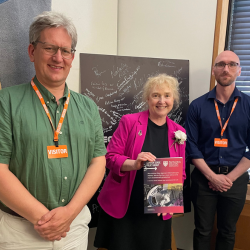
Professor Howard Reed from ֲýƵ, Irene Campbell MP, Chair of the All-Party Parliamentary Group on Phasing Out Animal Experiments in Medical Research, and Professor Elliott Johnson from ֲýƵ.
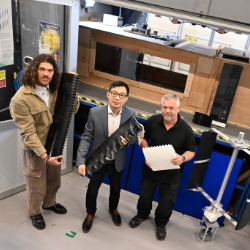
three man standing in front of a wind tunnel holding prototype parts of a wind turbine blade
Dr Colin Richardson, an Assistant Professor in Business Information Systems and Data Analytics, has been awarded an OBE for services to fire service operations and firefighter safety.
More events

Upcoming events

REVEAL Architecture
-
REVEAL Interior Design
-
REVEAL Fashion Exhibition
-
REVEAL Graphic Design
-
Back to top