ֲýƵ

Skip navigation

Northumbria experts help unveil the secrets of Jamaican sprinting success

23rd December 2014

RESEARCHERS have discovered that symmetrical knees are the secret behind Jamaica’s sporting prowess.

Jamaica has produced some of the world’s fastest athletes – including record-breaker Usain Bolt – so academics from ֲýƵ joined a team of experts to investigate the small nation’s sporting success.

Their findings reveal that the symmetry of the knees and the ankles can impact on a person’s running speed. It suggests the more symmetrical the knees, the faster a person will run.

UK academics Kris McCarty, a research fellow in the Northumbria’s department of Psychology, and Mark Russell, a senior lecturer in the Sport, Exercise and Rehabilitation department, were part of a team of experts who travelled to the Caribbean island this year to carry out the research.

Kris said: “We specifically wanted to look into the success of Jamaican elite sprinters – the best of the best – because the country has so many record holders for sprint events.

“We flew to Jamaica in March where we took measurements from an elite track and field team in Kingston, as well as from a large sample of everyday Jamaicans.

“The findings show us there is a relationship between knee symmetry and running speed, although it is not known at this stage if the sprinters are great because their knees are symmetrical, or if their knees are symmetrical because of the time spent practicing and training.”

The team measured the knees of 74 elite athletes as well as doing the same with a control group of 116 non-sprinting Jamaicans of the same age and sex, and similar in size and weight. They discovered that the sprinters’ knees were much more symmetrical than the knees of people in the control group.

The participating sprinters were all members of the MVP Track and Field Club, and included Shelly Ann Fraser-Pryce, who holds two Olympic gold medals in the 100-metre sprint, and Nesta Carter, the man with the fifth-fastest 100-metre record.

Thirty of those sprinters who specialise in the 100-metre race, which does not require runners to turn, were found to have the most symmetrical knees of all.

Although scientists can already predict how fast a non-trained person will run when they are older, by looking at the symmetry of the knees in childhood, this is the first time any research has isolated a variable that predicts sprinting speed in current athletes.

The research was funded and led by Professor Robert Trivers, an award-winning and , and co-authors working alongside ֲýƵ’s experts include included Bernhard Fink, University of Gottingen, Germany; Brian Palaestis, Wagner College, New York; and Bruce James, MVP Track and Field Club, Jamaica.

Latest News and Features

Top 50 employer winner badge
AI mapping tool
THE Rankings
The North Edit
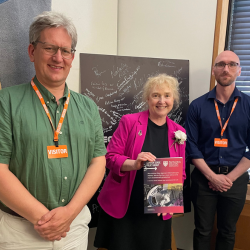
Professor Howard Reed from ֲýƵ, Irene Campbell MP, Chair of the All-Party Parliamentary Group on Phasing Out Animal Experiments in Medical Research, and Professor Elliott Johnson from ֲýƵ.
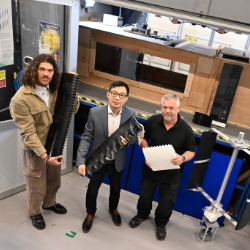
three man standing in front of a wind tunnel holding prototype parts of a wind turbine blade
Dr Colin Richardson, an Assistant Professor in Business Information Systems and Data Analytics, has been awarded an OBE for services to fire service operations and firefighter safety.
More events

Upcoming events

REVEAL Architecture
-
REVEAL Interior Design
-
REVEAL Fashion Exhibition
-
REVEAL Graphic Design
-
Back to top