Business and Law Building (CCE1) ÀÖ²¥´«Ã½ÊÓƵ
-


, the Regional Group of the , would like to welcome you to our annual Research Symposium, which showcases the varied immunological research themes within the North East. This year's event takes place at ÀÖ²¥´«Ã½ÊÓƵ.About this event
This full-day research event gives special focus to PhD and early career scientists who have the opportunity to present their work either as a talk or poster. We will also host two keynote speakers from outside the North East, who are either establishing or are established within their respective fields.
The day offers a great opportunity to form networks, collaborations or just to find out what research work is going on within the North East.There will be plenty of opportunity for attendees and presenters to meet during tea/coffee, lunch and end of day refreshments.The event is sponsored and presenters have the opportunity to win prizes for their talks and posters.
The event is open to academics, undergraduate, masters and PhD students and anyone who may have a general or passing interest in immunology from the North East universities and hospitals, as well as research communities outside the North East.
Abstract submission now closed. for short talks or poster presentations on any immunology-related topic. Submission deadline 31st May 2024.
We are pleased to host two keynote speakers. Please click below to view speaker profiles and abstracts.
, Professor of Precision Medicine, Director of the JDRF/Wellcome Trust Diabetes and Inflammation Laboratory (DIL), Oxford University
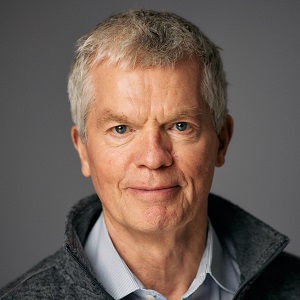
Genetic analysis of type 1 diabetes has revealed the major causative pathways of disease, notably HLA class II and the T cell repertoire, the IL-2 pathway, and the microbiome. Each of these offers opportunities to treat and prevent the disease. I will summarise our ongoing efforts in these three areas.
, tropical disease expert at Hull York Medical School.
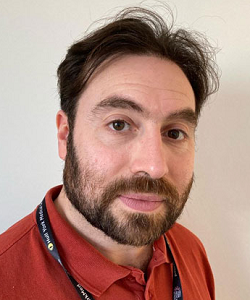
Although the triggers for autoimmune disorders are diverse and, in many cases, unknown, some pathogens have the outstanding capacity to alter our immune system leading to malfunctioning and autoimmunity. Our laboratory is currently exploring the mechanisms that regulate infection-driven autoimmunity, particularly focusing on infection-driven heart disease. Cardiovascular diseases are the leading cause of death globally. The immune system plays a key role in cardiac development, composition, and function. Under some circumstances, particularly in response to infection, immune cells can infiltrate the heart in large numbers to remove dying tissue, scavenge pathogens and promote healing. If uncontrolled, these immune cells can cause collateral tissue damage, leading to heart dysfunction and failure. Moreover, the heart can be directly affected by autoreactive B cells, resulting in damage to its structures.
Our goal is to better understand how the B cells that fight infections and those that attack the heart develop, and to identify the cellular and molecular mechanisms through which autoreactive B cells contribute to heart tissue damage. For this, we are using Trypanosoma cruzi as an infection model. T. cruzi is the protozoan parasite that causes Chagas disease (American trypanosomiasis), a major cause of infectious heart disease worldwide and the highest-impact parasitic disease in the Western Hemisphere. In response to T. cruzi infection/Chagas disease, and driven by poorly understood triggers, the immune system produces both antibodies against the parasite and against the body’s heart. Using a combination of molecular and cellular technologies (scRNA-seq, spatial transcriptomics, RNAScope, flow cytometry) we have now identified that chronic T. cruzi infection leads to a large and very unusual accumulation of B cells in the heart. During the talk, I will discuss our most recent datasets studying the immune response during experimental Chagas heart disease. I will also discuss our plans for studying the nature of these heart-resident B cells, how do they interact with other types of heart-resident cells (e.g. fibroblasts, cardiomyocytes) and ultimately, whether and how do they contribute to development of heart fibrosis and/or dilated cardiomyopathy.
Click below to view the sessions or (pdf) here.
09:00-09:50 Arrival, refreshments, poster set up
10:00-10:50 Dr Damian Perez Mazliah, York University - 'Transcriptomics of the immune response in Chagas heart disease'
10:50-11:20 Break and poster session
11.20-11:40 Samuel Higginbotham – ‘Neutrophils in steatosis’
11.40-12:00 Ioana Nicorescu – ‘TolDC affect on T cell gene expression’
12.00-12:20 Oana Sebedean – ‘Regulation of Immune Cell Development by IRF8’
12:20-12:40 BIO-RAD laboratories - ‘Ten ways to improve your flow data to get the right result’
12:40-13:00 AGM
13:00-14:15 Lunch and poster session
14:15-15:05 Prof John Todd, Oxford University - 'From genes to clinic in type I diabetes'
15:05-15:25 Michael Mulholland - ‘Interferon-gamma contributes to disease progression in the Ndufs4(-/-) model of Leigh syndrome’
15:25-15:45 Rui Chen - ‘NUDCD3 deficiency disrupts VDJ recombination to cause SCID and OMENN syndrome’
15:45-16:05 Anneliza Andreadi - ‘The role of Complement Factor I Rare Genetic Variants in Age Related Macular Degeneration in Finland’
16:05-16:30 Break and poster session
16:30-16:50 Beth Gibson – ‘In from the cold – HDM-FH protects human kidneys in a simulated organ transplant model’
16:50-17:10 Steven James Bolton – ‘Extracorporeal Photopheresis in the treatment of Chronic Lung Allograft Dysfunction’
17.10-17:30 Devyani Bhide – ‘Development of an in-vitro adenoidal co-culture model for the study of upper airway immunity in children adenoidal culture and upper airway infection’
17.30 -19.00 Prizes, closing comments and refreshments.

Please complete this to book your free place at the INE Research Symposium.
For any queries, please email Georgia Stylianou at georgia3.stylianou@northumbria.ac.uk
Business and Law Building (CCE1), ÀÖ²¥´«Ã½ÊÓƵ, Falconar Street, Newcastle-upon-Tyne, NE2 1XA
City Campus Map (building 5) | | | .
|
The Business and Law Building (CCE1) is a 3 minute walk from Manors metro station. .

ÀÖ²¥´«Ã½ÊÓƵ has been named one of the 50 GREAT British Employers of Veterans 2026…
Artificial intelligence is being adopted across policing and the wider criminal justice system…
ÀÖ²¥´«Ã½ÊÓƵ is officially one of the best universities in the world for sustainability,…
.png?modified=20260624091022)
ÀÖ²¥´«Ã½ÊÓƵ has published the first edition of The North Edit, a new high-quality…
New research commissioned by Lush shows the UK's non-animal methods sector grew to more than…
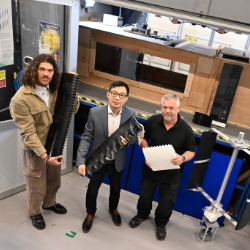
A ÀÖ²¥´«Ã½ÊÓƵ researcher has secured a prestigious national grant to redesign wind…

A ÀÖ²¥´«Ã½ÊÓƵ academic whose work has helped modernise fire service operations and…

Architecture Studios

City Campus East 2

City Campus East 2

Squires Workshops