
Find out more information about NESCA and all of the vital documentation needed to apply.
Key Dates:
opens:9th June 2026
Expression of Interest closes: 3 August 2026
Full Application Deadline: 20th September 2026 at 12pm
Award Notifications: December 2026
Project Start: January - March 2027 (no later than May 2027)

YOUR QUESTIONS ABOUT NESCA, ANSWERED.
Introduction
The Place Based Impact Acceleration Account (PBIAA) is an EPSRC scheme providing four years of funding to support a programme of impact activities within a research and innovation cluster. This PBIAA is designed to foster activities around resilient communications in space within and for the North East Region and will support the translation of university research to accelerate placed based impact. It is one of ten PBIAAs awarded in the second round of the scheme and is led by ÀÖ²¥´«Ã½ÊÓƵ, in collaboration with Durham and Newcastle Universities (‘the consortium’), along with regional civic and industrial partners.

Key Facts
Apply for funding to translate research into commercial or policy impact within resilient space communications, contributing to the growth of the North East space sector.
- Applications must be led by an academic or ECR based at Northumbria, Durham or Newcastle University
- Projects must include a non-academic industry or civic partner
- Funding supports research translation only — no fundamental research
- Three funding streams are available: Launch-pad, Lift-off, and the new Collaborative Lift-off Fund
- Project duration ranges from up to 6 months (Launch-pad) to 18 months (Lift-off and Collaborative Lift-off)
- Round 3 introduces the Collaborative Lift-off Fund — up to £100,000 for cross-institutional projects. Only three awards are available in this round
Applicant eligibility
Projects must be submitted and led by an Academic or ECR staff member on the payroll at one of the partner Universities - Northumbria, Durham, Newcastle.
Projects should include non-academic partners[2]. Eligible project partners can be industrial, civic, standards agencies, trade bodies, charities, and research trade organisations from the North East region[3].
Applications led by, or with a significant proportion of team members drawn from, early career researcher communities (including post-doctoral researchers and researchers on fixed funding/ term contracts) are welcomed and encouraged.
PDRAs may be the Project Lead (PL) on the project. However, they must have an Academic Co-Lead (Co-L) named on the project.
Academic staff holding permanent contracts can be PLs and Co-Ls however, they should not normally cost their time within these projects and will be expected to be as match-fund (except PDRAs or equivalent, subject to no duplication with other funding streams).
Projects may include non-academic organisations from outside the region. However, they must clearly demonstrate how the partnership and outcomes of the project will benefit and have a positive impact on the North East region.
All applications must be approved and signed-off by the PL’s Head of School/Department to ensure that the applicant can apply for funding in line with their employment contract and existing workload commitments.
[2] Projects supporting a spin-out proposal, where collaboration would put IP at risk, will not require an external partner to apply, but should still provide a letter of support from a customer/ end user / future buyer.
[3] A useful list of North East Industrial companies can be found here
Projects must support the growth of the North East space-based economy through one or more of the following:
- Development of new or enhanced technologies that accelerate the commercialisation of research
- New partnerships with non-academic organisations, particularly from adjacent sectors that could drive space sector growth
- Influencing policy or developing expert capabilities
Projects must build on completed research and demonstrate a clear pathway from research outputs to impact in the North East. Applications that read as redrafted research proposals are unlikely to succeed.
All projects must include a signed letter of support from at least one non-academic partner on headed paper, confirming their commitment and contribution.
NESCA themes
Projects must align with one of the following themes:
- Technologies — e.g. EM spectrum materials, device fabrication, system integration, integrated sensing and communication
- Space Sustainability — e.g. space law, policy, governance, in-orbit servicing, operations
- In-Space Opportunities — e.g. low-latency LEO, interlinks
- Terrestrial Applications — e.g. Earth observation, climate and disaster management, healthcare, energy
- Smart & Resilient Networks — e.g. data analytics, machine learning, smart networking, on-board AI edge processing
Policy projects and societal impact activities are eligible — not just commercialisation projects.
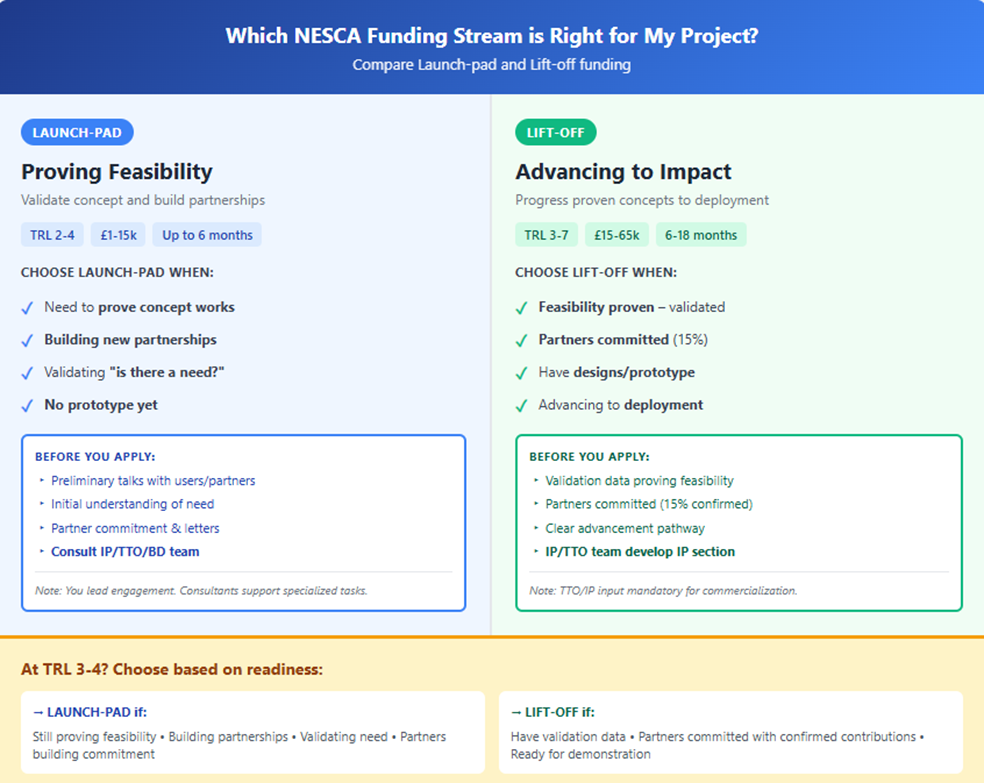
NESCA offers three funding streams. All projects require research translation — no fundamental research — and must include a non-academic partner. The project lead must be an academic or ECR at Northumbria, Durham or Newcastle University.
A) Launch-pad Fund
£1 – 15k per project
TRL 2-4
Duration up to 6 months
Seed funding for early-stage translation — idea feasibility, first steps towards commercialisation, and building new academia-industry relationships. Supports feasibility studies, early prototyping, market discovery, workshops and policy-influencing activities.
Partner contribution: A 15% in-kind contribution is welcome but not required.
Key question: "Could this work?"
B) Lift-off Fund
£15 – 65k per project
TRL 3-7
Duration 6 - 18 months
Sustained funding to deliver a defined impact — technology demonstrations, policy implementation, licensable technologies or prototype development and testing. For commercialisation projects, applicants must involve their university's IP or technology transfer team before applying.
Partner contribution: A 15% cash or in-kind contribution from a non-academic partner is expected.
Key question: "How do we make this work?" or "How do we deploy this?"
C) Collaborative Lift-off Fund (New for Round 3)
Up to £100,000 (£50,000 per partner HEI)
TRL 3-7
Duration 6 - 18 months
A new stream introduced in Round 3 for cross-institutional projects. The project must be led by a NESCA partner university (Northumbria, Durham or Newcastle) with a co-lead from any other UK university outside the NESCA consortium. Only three awards are available. All standard Lift-off eligibility requirements apply. Check with your institution's IAA or IP team before applying.
Partner contribution: A 15% cash or in-kind contribution from a non-academic partner is expected, as per the standard Lift-off Fund.
Key question: "How do we make this work?" or "How do we deploy this?"
Awards cover directly incurred costs only. VAT must be included as universities cannot reclaim it. Non-academic organisations cannot receive NESCA grant funding directly.
Download the full Application Guidance for eligible and ineligible costs .
Applicants should cost their proposals in accordance with their Partner University guidelines.
Proposals should be costed using Directly Incurred (DI) costs without Indirect or Estates costs. All proposals must have received institutional approval before submission.
Eligible costs:
- RA/ PDRA/ Technician/ Professional support salary costs for staff employed on Northumbria, Durham or Newcastle University payroll
- RA/ PDRA Technician/ Professional support salary costs for staff employed on a partner HEI payroll in a collaborative project with either Newcastle, Durham or ÀÖ²¥´«Ã½ÊÓƵ as the lead applicant.
- Reasonable travel, accommodation, and subsistence costs are covered in accordance with the awarding university’s expenses and financial regulations policies (or equivalent).
- Consumables directly related to the project are eligible for funding but must be fully justified.
- Equipment must be under £10,000 including VAT (according to EPSRC guidelines).
- Salaries for partner university staff costed for less than 100% of time (e.g., PDRA, technician, etc.) are contingent upon the staff member completing a monthly timesheet and the PL/staff member retaining records and producing these in case of audit (please refer to UKRI’s terms and conditions).
-
Other costs such as registration costs at events, production of professional materials, room bookings, catering, etc., are eligible if relevant to the project.
-
Outsourcing and professional fees– following institutional financial regulations and needing to be justified.
Applicants should provide a project costing with their proposal, which must be prepared in conjunction with the relevant research finance office at their university. You should provide full financial details of the project, including salary costs, travel and subsistence costs, additional consumables and any other fees associated with the project.
Awards will only cover the direct costs associated with the project. VAT must be included in the figures as the Universities cannot reclaim VAT from this project.
Ineligible activities/costs:
- New, fundamental research (TRL 1).
- Academic supervision (Investigator DI or Investigator DA – see previous exceptions).
- Non-Specific Public Engagement activities and science communication.
- Any costs relating to intellectual property protection including but not limited to registering, maintaining, or supporting patents or property rights.
- Undergraduate or postgraduate activities/training, e.g. core PhD training including stipend, training, tuition, bursary or bench fees.
- Items of equipment with an individual value of £10,000 or more (items of equipment over £500 must be detailed in the justification of resources).
- Standard IT equipment (i.e. laptops, i-pads, etc... )
- Indirect costs, estates, or infrastructure.
- Projects outside the scope of the NESCA programme (or call).
- Broader activities and institutional culture change relating to impact.
- Impact activities that should already have been anticipated and supported through standard routes, e.g. impact activities costed as part of research proposals.
-
Duplication of other sources of funding that can be used more appropriately for the impact activity within remit of Research Council, e.g. institutional IAA funds, CLASP/IPS.
-
Projects that can be funded by other mechanisms are not eligible.
-
Directly subsidising commercial R&D.
-
Contributions to KTPs.
-
Teaching replacement costs
-
External non-HEI partner/ user salary costs cannot be funded by the NESCA grant. In-kind or cash contributions should cover salary costs or costs for access to external partner facilities or provision of essential consumables / OEM parts evidenced for the project; where this is not the case, they can’t be a partner and must be listed as a supplier and following institution procurement rules must be followed, and evidence of this must be provided within the justification of resources section and treated as contractor costs.
-
Non-academic organisations cannot be recipients of NESCA grant funding.
-
No double funding – if applying for two sources of funding for similar work, if successful through NESCA the other application must be immediately withdrawn i.e. Northern Accelerator (or vice-versa).
-
Funds cannot be used for purely academic conference attendance. Note that costs associated with attendance at workshops / conferences will be only considered where 75% non-academic audiences will be present, there is clear outcomes of knowledge translation, and the outcomes must be detailed in the justification of resources section of the application.
IP, subsidy control and partners
Recommended Intellectual Property requirements
These recommendations are subject to local agreements at your University (please ensure to seek clarity from your TTO / IP Team – Northumbria University applicants MUST follow the steps below)
- The industry partner must not seek a pre-negotiated right to any academically generated foreground project IP.
- Under some circumstances, it may be acceptable for the partner to receive a non-exclusive licence to use any data generated by the project for internal research and development purposes, where this explicitly excludes any rights to, or capacity to, prevent exploitation of the data by the academic party.
- The company partner may have a right to negotiate for access (at a fair market price) to the academic party’s IP, but terms cannot be agreed upon until the project is completed
- Any other terms must be discussed with your TTO/ IP Team and due consideration of subsidy control made.
Subsidy Control
The submitting organisation must ensure at all times that any NESCA grant funding awarded to you is compliant with the Subsidy Control Act 2022. You must inform the NESCA Project Manager of any other public funding applied for or awarded against the eligible costs covered by the grant. We will immediately suspend the Grant and may require you to repay Grant funding if you are found to have received aid that is deemed to be in breach of the Subsidy Control Act 2022. No subcontract or other agreement with a Third Party can be made which would constitute a breach of the Subsidy Control Act 2022.
If existing university spinouts are the industry partner, the project must not be developing IP already licensed to the spinout.
Partners' Letters of Support
Partners can be end-users or collaborators. Eligible project partners can be industrial, civic, standard agencies, trade bodies, charities, and research trade organisations from the North East region. Where they are from outside of the region clear justification and details on how their involvement in the project will lead to impact for the region must be stated ().
It is expected that non-academic partners will each make a 15% match funding contribution to EPSRC PBIAA projects, such as NESCA. However, the cash or in-kind contribution should be appropriate to the size and type of the partner organisation, and deviations from the 15% will be in exceptional circumstances and should be explained. Non-academic partners will need to demonstrate their commitment to the project, and applications should detail how participants will work together to achieve the aims and objectives of the project.
Trusted Research and Due Diligence
Trusted Research (TR) and Responsible Research and Innovation (RRI)
Trusted Research and Responsible Research and Innovation (RRI) underpins all work that NESCA will conduct. Expertise and clear escalation points will be built into the application process and ongoing monitoring of projects by awardees and the lead institution will take into account EPSRC expectations for trusted research -
It is not anticipated that applicants / HEI recipients of funding will be involved with partners or organisations owned/controlled by overseas entities, but due diligence conducted by the responsible party (i.e. the applicant) should highlight any evidence of this so a decision can be made by the funding panel on a case-by-case basis.
All parties involved in projects must transparently consider and address trusted research considerations and implement appropriate mitigations where relevant.
Applicants must fill out the Trusted Research checklist as part of their application. Trusted Research will not be part of the initial assessment, but a final decision will be made by the Funding Panel as to whether they believe funding the activity will be consistent with . As part of their responses, applicants should consider and detail whether any relevant legislation applies to their proposed partners or their work including:
- Export Control Order (2008)
- The National Security and Investment Act (2021) (NSI),
- Academic Technology Approval Scheme (ATAS)
- The Foreign Influence Registration Scheme (FIRS)
- Whether the work is of a sensitive or nature.
Within the checklist, you will be asked to consider how any relevant legislation applies to your work. Answers to the checklist should also include how the applicant intends to apply the appropriate mitigations to any inherent risks within their work throughout their project's lifecycle.
Whilst collaboration with international partners is not anticipated under this programme, there is potential for international parties to access information or technology through third-party relationships or activities undertaken as part of awarded projects. HEI award recipients are responsible for completing due diligence and ensure they are not in breach of any legislation mentioned above by collaborating with international partners or sub-contractors which may be in scope of such legislation; this will be set out clearly in the terms of award.
If there is collaboration with entities owned or controlled overseas, activities must only proceed following further consultation with applicant university’s in house trusted research expert, and, if required, an assessment of whether key legislation applies including Export Control, NSI or ATAS.
Successful award holders will receive further resources and guidance on Trusted Research training through NESCA including an appropriate checklist to monitor the project on an ongoing basis.
Step 1 — Complete an Expression of Interest
The EOI opens on 9 June 2026 and closes on 3 August 2026. Complete the form at northumbria.ac.uk/NESCA. You must submit an EOI to access the full application.
Step 2 — Get support before you apply
Speak to your institution's NESCA professional support team before submitting. Contact the EPSRC IAA team at Durham or Newcastle, the Business Development or IP/TTO team at Northumbria or Newcastle, or the NESCA Programme Manager at Northumbria for policy or societal projects. Email NESCA@northumbria.ac.uk if you are not sure who to contact.
Step 3 — Gather your supporting documents
A signed letter of support from your non-academic partner on headed paper, confirming their commitment and contribution
For commercialisation projects: a review of the IP section by your university's TTO or IP team
Sign-off from your Head of School or Department confirming you can apply in line with your contract and workload
Step 4 — Submit your application
The full application deadline is 30 September 2026 at 12pm. Applications can only be submitted through the online system after an approved EOI. Proposals are reviewed blind — keep references to yourself and co-leads to a minimum within the body of the proposal to avoid potential bias.
What happens next
Each proposal is reviewed by three reviewers, at least one of whom is non-academic. Scores and comments are collated and discussed at a panel meeting. The panel's decision is: Fundable, Fundable with revisions, or Not Fundable. Applicants receive anonymised feedback after the panel meeting. Award notifications are expected in December 2026.
If you were unsuccessful in a previous round, you may apply again provided you have addressed the reviewer comments. The NESCA Programme Manager at your institution will confirm whether the changes are sufficient before resubmission.
Applications are scored 1–5 against seven criteria by three independent reviewers (at least one non-academic). All proposals are anonymised before review. The panel then decides: Fundable / Fundable with revisions / Not Fundable.
A proposal that does not demonstrate credible regional North East impact (C6) cannot be recommended as Fundable regardless of scores in other criteria.
| Criterion | What reviewers consider |
| C1 |
Alignment, understanding of need and background research Does the proposal demonstrate a clear understanding of the need, market or policy driver? Does it build on completed prior research and align with a NESCA theme, with a clear translation focus? |
| C2 |
Value for money and timeliness Are costs proportionate and well justified? Is the timeline realistic? Do the anticipated impacts exceed the funding requested? |
| C3 |
Co-creation and partnerships Is the partner suitable? Is their commitment evidenced by a signed, dated letter on headed paper with contributions quantified? Are roles clearly defined? |
| C4 |
Project plan and risk management Are objectives and milestones clearly defined? Are risks identified with realistic mitigations? Does the team have the capacity to deliver? |
|
C5 |
RRI, EDI, sustainability and Trusted Research Are intended and unintended impacts anticipated? Is there a plan for stakeholder engagement throughout the project? Are EDI principles embedded and the Trusted Research checklist complete? |
| C6 |
Progression, outcomes and regional impact CRITICAL. A proposal without credible regional North East impact cannot be recommended as Fundable. Does the project contribute to economic growth, skills, innovation or policy in the North East? Are outputs, outcomes and impacts clearly defined with a credible follow-on plan? |
| C7 |
IP management and route to market or impact Is IP ownership clear? Is there a credible route to market, policy adoption or societal benefit, with socio-economic benefits identified? |
Before submitting all applicants must complete in-house RRI training or attend a NESCA online RRI webinar.
Download full reviewer guidance .
For help with costings and writing your proposal, contact your research office first.
For IP commercialisation queries, contact your institution's IP, TTO or Business Development team.
For all other queries about this funding opportunity:
Email: NESCA@northumbria.ac.uk
Website:
If you are not sure which team to contact, email NESCA@northumbria.ac.uk and we will direct you to the right person.
Post-Award Requirements:
- Awardees will receive a formal award letter from ÀÖ²¥´«Ã½ÊÓƵ which will set out the terms of the grant.
- Grant holders must ensure that a collaboration agreement is in place between HEI and Non-HEI partners, and this formalises all partners' IP position.
- Projects will be paid in arrears on the submission of completed financial claim forms and project monitoring reports within the periods set out in the offer letter.
- If successful, all projects must be ready to start within three months of date of the award letter.
- The applicant University is responsible for ensuring a separate and appropriate collaboration agreement must be in place between collaborating partners in the awarded project.
- External collaborators must be vetted by the submitting partner HEI through a due diligence / risk review process before application, and evidence that this has occurred will be checked again before the project commences and funding is released. The Trusted Research checklist must be completed and updated should there be any changes to the status of the collaborating non-HEI partner.
- If a no cost extension is required, a request should be made to the NESCA Project Manager, NESCA@northumbria.ac.uk, accompanied by appropriate justification. Requests for extensions beyond the end of the PBIAA funding period (31st April 2029) will not be permitted.
- Successful applicants must inform the NESCA Project Manager, Nesca@Northumbria.ac.uk, if they are awarded funding from other schemes to support the same or similar activities.
Marketing and Communication
Successful applications will be required to:-
- Provide information about their project for marketing and communication purposes (maintaining confidentiality of intellectual property where appropriate)
- Provide project updates, case studies and short films summarising the project and its impact for publication on the NESCA website, social media and for publication of the EPSRC
- Attend NESCA showcasing events, roundtables, or sandpits to facilitate further regional impact and knowledge exchange and to foster future collaborative opportunities.
- All publications relating to NESCA funded projects must cite the NESCA EPSRC grant reference number: EP/Z536301/1 and must include the NESCA & EPSRC logo and relevant branding on all online or printed materials (including press releases, posters, exhibition materials and other publications) related to activities funded by this grant.
Reporting Requirements
All successful projects must participate in the collection of Key Performance Indicators (KPIs) during and after project completion and will be expected to participate in future capacity building events and public engagement activities to share their experience and develop expertise.
The Project Lead (PL) of each funded project will be required to submit:-
- For projects with a 7-month plus duration - a mid-term project update summarising the activities carried out to date, requesting any adjustments to budget headings, timelines or plans, indicating key risks and challenges and listing KPIs achieved to date.
- End of project report summarising progress against key tasks, deliverables and main achievements on the activities carried out, listing all outcomes and impacts achieved (or expected future impacts).
- Post project follow up – A member of the NESCA Team could follow up for a period of up to 3 years after the project end to find out about outcomes and impacts achieved after the end of project report.
- By accepting the award, the applicants agree to respond to requests for additional information from the NESCA PM or their institutions NESCA PM, IP Team or Business Development Team.
For information, the outputs, outcomes, and impact measures that UKRI ask us to report on and NESCA-specific KPIS are detailed in .
The NESCA Project Team or Innovation / Business Development teams at your University will monitor project progress both during the life of the project and post-project to allow the reporting of outcomes and capture of impact. This will include making non-confidential aspects available to assist with the development of case studies.
Page last updated 25/06/26
